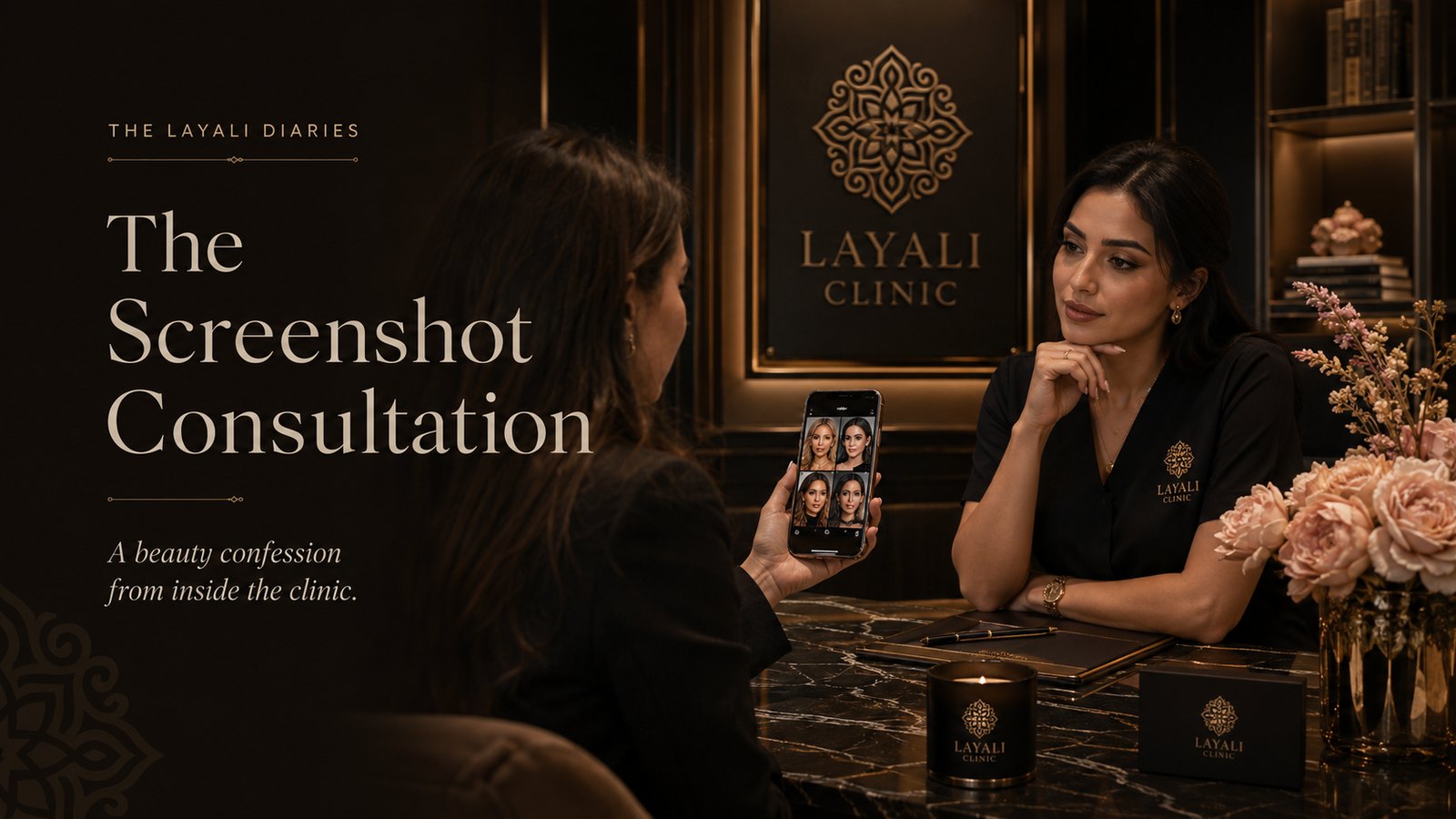
She arrived with ten screenshots and one very determined expression.
Not nine.
Not eleven.
Exactly ten.
Each photograph featured a different woman, but somehow they all had the same face.
High cheekbones.
A tiny nose.
A perfectly sculpted jawline.
Large eyes.
Full lips.
Flawless skin without a pore, shadow or expression line in sight.
She placed her phone on the consultation desk and began swiping.
"I like her lips," she said.
Swipe.
"Her cheeks."
Swipe.
"Her chin."
Swipe.
"And this jawline."
By the time she finished, we had assembled a face from four celebrities, three influencers and one woman whose identity remained a mystery because the filter had removed most of her recognisable features.
Then she looked at me and asked:
"Can you make me look like this?"
The honest answer was no.
The more important answer was that she should never have been made to believe she needed to.
The face inside the folder
She had been collecting the photographs for months.
Whenever she saw a feature she liked, she saved it.
A nose from one face.
Lips from another.
Cheeks from somebody else.
Eventually, her camera roll had become a catalogue of individual parts.
None of the women looked like her.
Some did not even look like themselves.
But she had studied the images so often that the edited proportions had started to feel normal.
Her own face had become the exception.
"I know I won't look exactly like them," she said, sensing my hesitation. "I just want the same kind of look."
"What is it that you like about the look?" I asked.
She paused.
"The balance."
That was interesting.
Because balance was exactly what could be lost if we tried to copy it.
Inspiration is not an instruction manual
Bringing photographs to a consultation is not a bad thing.
Images can help a client explain what they are drawn to.
Perhaps they prefer a softly defined lip rather than a dramatic border.
Perhaps they like gentle cheek projection rather than a sharp contour.
Perhaps they want a chin that appears more balanced in profile.
The problem begins when an inspiration photograph becomes a blueprint.
A treatment does not happen on a blank canvas.
It happens on a living face with its own:
- Bone structure
- Soft tissue
- Skin quality
- Facial movement
- Natural asymmetries
- Proportions
- Expressions
- Medical history
- Treatment history
A lip shape that looks beautiful on one person may not suit another person's mouth, profile or lower face.
A projected chin may improve one face and overpower another.
A sharply contoured jawline may look elegant on someone with a particular structure but heavy or unnatural on somebody else.
The feature cannot be separated from the face it belongs to.
That is the part screenshots often hide.
The celebrity face that did not exist
We opened the first photograph again.
The woman's skin was completely smooth.
Her nose appeared tiny.
Her eyes were unusually large.
Her jawline narrowed into a delicate point.
The lighting was perfect, the angle was controlled and the image had almost certainly been edited.
"How do you know it's filtered?" she asked.
I pointed to the background.
A doorframe beside the woman's jaw had developed a slight curve.
The filter had not only changed the face.
It had bent the room around it.
We checked another image.
The skin texture had disappeared.
In the next one, both sides of the face were almost perfectly symmetrical.
Real faces are rarely perfectly symmetrical.
Real skin has texture.
Real eyes crease when we smile.
Real lips move when we speak.
Real jawlines soften depending on posture, lighting and angle.
She had been comparing her living, moving face to still images that had been posed, selected, adjusted and possibly altered before she ever saw them.
It was not a fair competition.
Why the same treatment looks different on everyone
She wanted the lips from the first image.
They were full through the centre with a sharply defined cupid's bow and a short distance between the nose and upper lip.
Her own anatomy was different.
She had a naturally longer upper lip area, a softer cupid's bow and good existing volume through the lower lip.
Trying to force the exact same shape onto her face would not create the photograph.
It would create a version of her lips that had been treated without respecting where they began.
The same applied to the cheeks.
The celebrity photograph showed very high, prominent cheekbones. My client had a softer facial structure and naturally fuller cheeks.
Adding significant projection simply because it looked attractive on someone else could have made her midface appear heavier rather than more sculpted.
More product does not automatically create more definition.
Sometimes it only creates more face.
The consultation mirror
I asked her to put the phone down.
Then we looked at her face in the mirror.
At first, she continued describing what she lacked.
Her chin was not sharp enough.
Her cheeks were not high enough.
Her lips were not defined enough.
Her jawline was not narrow enough.
Every feature was measured against someone else.
So I asked a different question.
"What do you like about your face?"
She laughed as though I had asked something unexpected.
"I don't know."
There it was.
Not a lack of beauty.
A lack of familiarity with her own beauty.
She had spent so much time studying other women that she had stopped looking at herself as a complete person.
Your face is a relationship between features
Aesthetic treatment should not be a shopping list.
One millilitre for the lips.
Two for the cheeks.
One for the chin.
Another treatment for the jaw.
A face is not a collection of independent areas that can be upgraded separately without affecting the whole.
Every change alters the relationship between features.
Increasing lip volume may change how the chin appears.
Projecting the chin may affect the balance of the nose in profile.
Adding cheek volume may change the way the lower face is perceived.
Creating a sharper jawline may not suit the softness of the remaining features.
This is why treatment planning should begin with proportion rather than product.
The question is not:
"How do we recreate this celebrity?"
It is:
"What would improve balance while still preserving your identity?"
The danger of becoming a trend
There is always a face of the moment.
One year it is extremely full lips.
Then it is lifted, heavily projected cheeks.
Then a tiny upturned nose.
Then a long, narrow chin.
Then a jawline sharp enough to cut through the algorithm.
Trends move quickly.
Your face has to live with them for much longer.
A feature that looks fashionable on social media today may feel completely disconnected from you once the trend changes.
That does not mean clients should avoid noticeable results or personal preferences.
It means treatment should still make sense when the inspiration post has disappeared from your feed.
A face designed around trends can start to look dated.
A face treated with respect usually remains recognisable.
"But I want a transformation"
She had not come for an almost invisible adjustment.
She wanted to feel different.
That did not automatically make her request unreasonable.
Some clients genuinely prefer a more defined or glamorous aesthetic. Natural does not have to mean undetectable, and subtle is not the only acceptable style.
But transformation still requires boundaries.
We could create more lip definition.
We could consider improving the balance of her profile.
We could discuss carefully selected structural support.
What we could not do was guarantee that four different celebrity features would combine successfully on her face.
A practitioner should not agree to an unsuitable plan simply because the client understands that it will look "dramatic."
Consent does not make poor treatment planning responsible.
The screenshot test
We went through every image again.
This time, instead of asking which feature she wanted, I asked what feeling each photograph gave her.
The first looked feminine.
The second looked polished.
The third looked confident.
The fourth looked glamorous.
The fifth looked powerful.
Suddenly, the consultation changed.
She did not really want a specific pair of lips.
She wanted to feel feminine.
She did not need a celebrity's chin.
She wanted her profile to feel more balanced.
She did not need an influencer's cheekbones.
She wanted to look polished without relying on heavy contouring.
Those were goals we could work with.
Not because feelings can be injected.
But because we could translate vague inspiration into realistic treatment priorities.
What we found
When we assessed her face properly, the feature affecting her profile most was not her nose, as she had assumed.
It was the relationship between her lips and chin.
Her lips already had good natural volume, but the upper border could be defined more carefully.
Her chin was slightly under-projected in profile, although any treatment would need to remain proportionate to her soft facial shape.
Her cheeks did not need the dramatic volume she had saved in the photographs.
In fact, adding too much there could have made her face appear wider.
Her jawline did not need to be aggressively sharpened either.
The goal was not to remove every sign of softness.
Softness was part of what made her face attractive.
The treatment plan
We did not perform four treatments that day.
We agreed on a staged plan.
First, we would focus on gentle lip definition while preserving her natural shape.
Then we would allow the result to settle.
Afterwards, we could reassess her profile and decide whether subtle chin support would create a meaningful improvement.
The cheeks and jawline were left alone.
Not forgotten.
Not postponed as part of a sales strategy.
Simply left alone because they did not need to be treated.
She looked surprised.
"I thought you would recommend everything."
That is often what clients expect from a consultation.
A list of problems followed by a larger list of treatments.
But a consultation should not create insecurities that did not exist before the appointment.
It should organise the concerns the client already has, identify what is realistic and remove anything unnecessary.
Sometimes the best treatment plan becomes smaller as the conversation improves.
Two weeks later
She returned for her review with only one screenshot.
Her own before photograph.
We placed it beside the new image.
Her lips looked more defined but still belonged to her.
The overall change was visible without dominating her face.
We reviewed her profile and discussed the chin again.
This time, she was not comparing herself to a celebrity.
She was comparing herself to herself.
"I think I understand it now," she said.
"What?"
"I don't want their face. I just want mine to look its best."
Exactly.
That is the consultation every practitioner hopes to reach.
Not because celebrity inspiration is forbidden.
Not because wanting change is wrong.
But because treatment becomes safer, more honest and more satisfying when the client stops trying to disappear inside somebody else's proportions.
The photograph she finally deleted
Before she left, she opened the folder on her phone.
The ten photographs were still there.
She deleted the image with the tiny filtered nose.
Then the one with the impossible jawline.
Then the photograph that had bent the doorframe.
She kept two images.
Not as instructions.
As references for the style she liked.
There is a difference.
Because the goal of aesthetic treatment should never be to make a client unrecognisable enough to resemble somebody else.
It should be to help her see the value in the face she already owns.
Filters can create symmetry.
Editing can erase texture.
Angles can manufacture proportions.
But individuality cannot be copied from a screenshot.
And the most successful treatment will never be the one that makes someone say:
"You look exactly like her."
It will be the one that makes them say: "You look like yourself—only more confident."
Until the next confession,
The Layali Diaries x