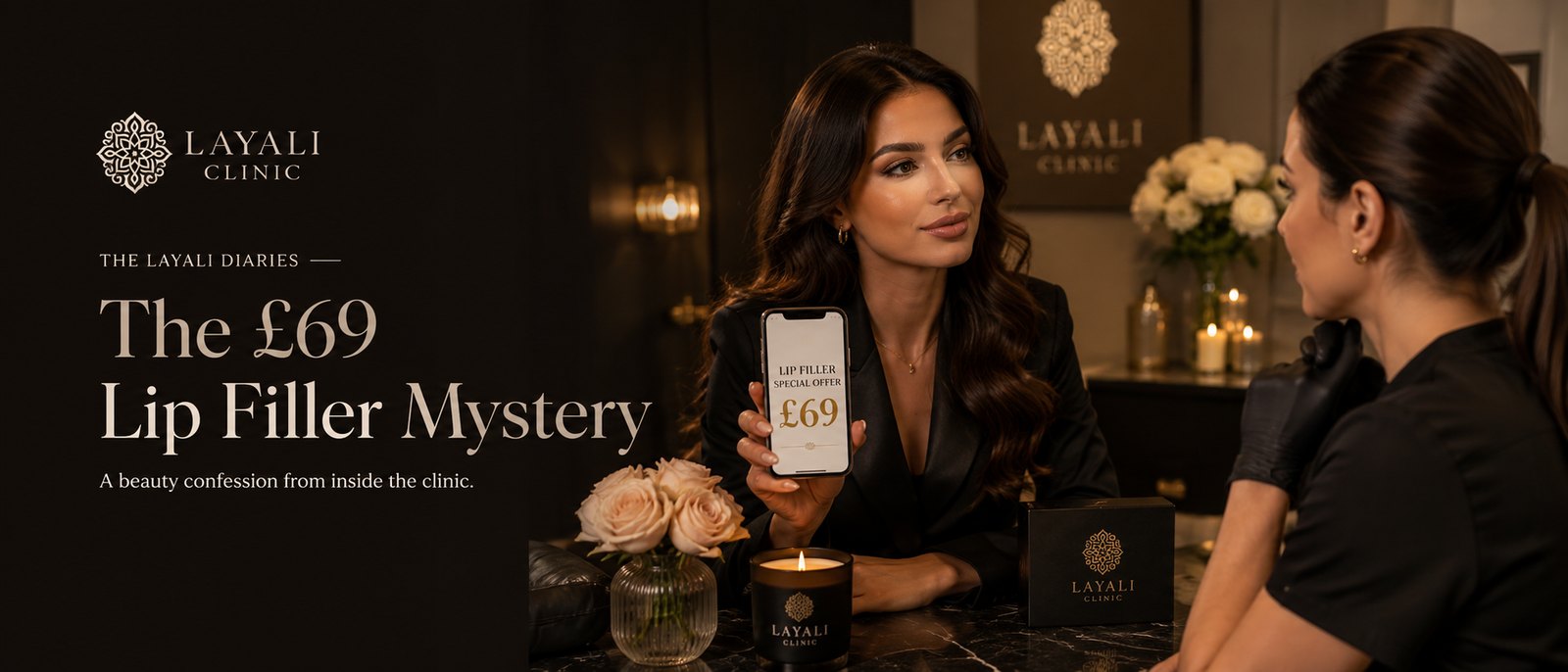
There are certain messages that appear in every aesthetic practitioner's inbox.
"Can you copy these lips?"
"How much for 1ml?"
And the classic:
"Another clinic is doing it for £99. Why are you more expensive?"
She asked the question before she had even taken off her coat.
No hello.
No small talk.
Just a screenshot held between two perfectly manicured fingers.
The advertisement was bright pink, covered in capital letters and decorated with enough exclamation marks to suggest the offer might disappear before midnight.
1ML LIP FILLER — £69
She placed her phone on the desk and looked at me.
"It's the same treatment, isn't it?"
An understandable question.
After all, 1ml is 1ml.
Or is it?
The offer that followed her across Instagram
She had been thinking about lip filler for months.
Not impulsively. Not because of a breakup. Not because somebody had made a careless comment about her appearance.
She simply wanted a little more definition through her cupid's bow and slightly more volume in her upper lip.
She had researched results, saved photographs and finally decided she was ready.
Then the advertisements began.
Lip filler for £150.
Lip filler for £120.
Lip filler for £69.
The prices became lower each time she refreshed her screen.
By the time she arrived at Layali Clinic, she was no longer asking which practitioner she trusted.
She was asking why she should pay more.
And that is where the mystery begins.
A syringe is only one part of the appointment
When clients compare prices, they often compare the amount of filler being advertised.
But they may not be comparing everything surrounding it.
The price of an aesthetic treatment can reflect more than the product inside the syringe. It may also account for:
- The practitioner's education, training and experience
- The quality and traceability of the product
- The consultation and medical assessment
- The time reserved for treatment
- The standard of the clinical environment
- Professional insurance
- Infection-control measures
- Emergency preparation
- Treatment records and photography
- Aftercare and follow-up support
- The willingness to manage concerns after the appointment
None of these things are particularly exciting to put on an Instagram graphic.
"Comprehensive medical assessment included" does not attract quite as much attention as "FLASH SALE."
But it becomes very important when something does not go to plan.
Does a low price mean the treatment is unsafe?
Not necessarily.
A lower price alone does not prove that a practitioner is unqualified, that the product is poor quality or that the treatment is unsafe.
Clinics set their prices for different reasons. A practitioner may be running a genuine introductory offer, building a portfolio, reducing their profit margin or temporarily promoting a particular treatment.
The problem is not simply that a price is low.
The problem is booking based only on the price without asking what sits behind it.
Who is performing the treatment?
What product are they using?
Where was it purchased?
Will the packaging be opened in front of you?
Have they assessed whether you are medically suitable?
Do they understand facial anatomy?
Can they recognise and respond to a complication?
What happens when the promotional post disappears but your swelling, concern or question does not?
Cheap does not automatically mean dangerous. Expensive does not automatically mean excellent.
Price is information, but it is not proof.
"But isn't all filler basically the same?"
No.
Different fillers have different properties and are designed for different purposes. A product chosen for structural support in one area may not be the practitioner's preferred choice for creating soft, natural movement in the lips.
The brand name is not the only consideration either.
The practitioner must understand the product they are using, how it behaves, where it should be placed and whether it is suitable for that particular client's anatomy and goals.
A legitimate, high-quality product can still produce a poor result if it is chosen or placed badly.
And an experienced practitioner should never treat a client simply because a syringe has already been opened or because a sales target needs to be met.
The product matters.
The hands using it matter too.
The part nobody wants to discuss
Most lip-filler appointments are completed without a serious complication.
But filler is still a medical aesthetic procedure.
Possible problems can include significant swelling, bruising, infection, asymmetry, lumps, migration, an unsatisfactory result and, more rarely, a vascular complication requiring immediate recognition and treatment.
No responsible practitioner should frighten a client.
But they should not pretend that the risks do not exist either.
Before treatment, you should understand what is being done, what the expected recovery may look like, which symptoms are normal and which symptoms require urgent attention.
You should also know how to contact the clinic afterwards.
A bargain feels very different when you are worried at 10pm and nobody is replying.
The screenshot investigation
I asked her whether the advertisement included the practitioner's name.
She zoomed in.
It did not.
I asked which filler was being used.
She checked the caption.
It did not say.
Was a consultation included?
She could not tell.
Was the practitioner insured?
No information.
Was there a follow-up appointment?
Nothing mentioned.
Could the clinic be completely legitimate despite the missing information?
Of course.
But she did not know enough to make an informed decision.
And that was the real issue.
She had spent more time checking the clinic's available appointment slots than checking who would be holding the syringe.
What are you actually paying for?
At Layali Clinic, you are not paying simply for a millilitre of gel.
You are paying for an individual assessment of your lips, facial proportions, medical history and desired outcome.
You are paying for a treatment plan that may sometimes involve less product than you originally requested.
You are paying for honesty when a shape is unrealistic, when your lips need time to settle or when more filler would not improve the result.
You are paying for someone to consider what happens before, during and after the injection.
Most importantly, you are paying for the confidence that your face is not being treated like the next space on a conveyor belt.
That does not mean the most expensive clinic is always the best.
A marble reception desk and a luxury postcode cannot inject filler.
Look beyond the décor.
Look at the practitioner.
The questions worth asking
Before choosing a clinic, ask:
Who will perform my treatment? Check the practitioner's identity, background, training and experience with the area being treated.
Which product will be used? Ask why it has been selected and whether the packaging can be shown to you.
Will I receive a consultation first? A proper assessment should happen before treatment, not after payment has removed your ability to reconsider.
What are the risks? You should receive a clear explanation without being rushed or dismissed.
What happens if there is a complication? The clinic should have an appropriate emergency process and explain how concerns are handled.
What support is available afterwards? Ask who to contact, what aftercare is provided and whether reviews are available when needed.
Do I feel comfortable saying no? You should never feel pressured into treatment because an offer expires that evening.
Her final decision
She did not book the £69 appointment.
She did not book with me that day either.
And that was perfectly fine.
I encouraged her to go home, research both clinics properly and decide based on where she felt safest and most comfortable—not which practitioner gave the most convincing sales pitch.
A week later, she returned.
Not because I had persuaded her that cheaper treatment was automatically bad.
But because I had not tried to frighten her into booking.
We created a subtle enhancement focused on definition and balance. She saw the product packaging, asked every question on her list and left knowing exactly how to contact me if she had any concerns.
At her review, she looked in the mirror and smiled.
"I understand the price now," she said.
But the truth is, it was never really about convincing her to pay more.
It was about helping her understand what she was paying for.
Because the most important mystery is not how a clinic can offer lip filler for £99.
It is why so many people are prepared to trust someone with their face before learning their name.
Until the next confession,
The Layali Diaries x