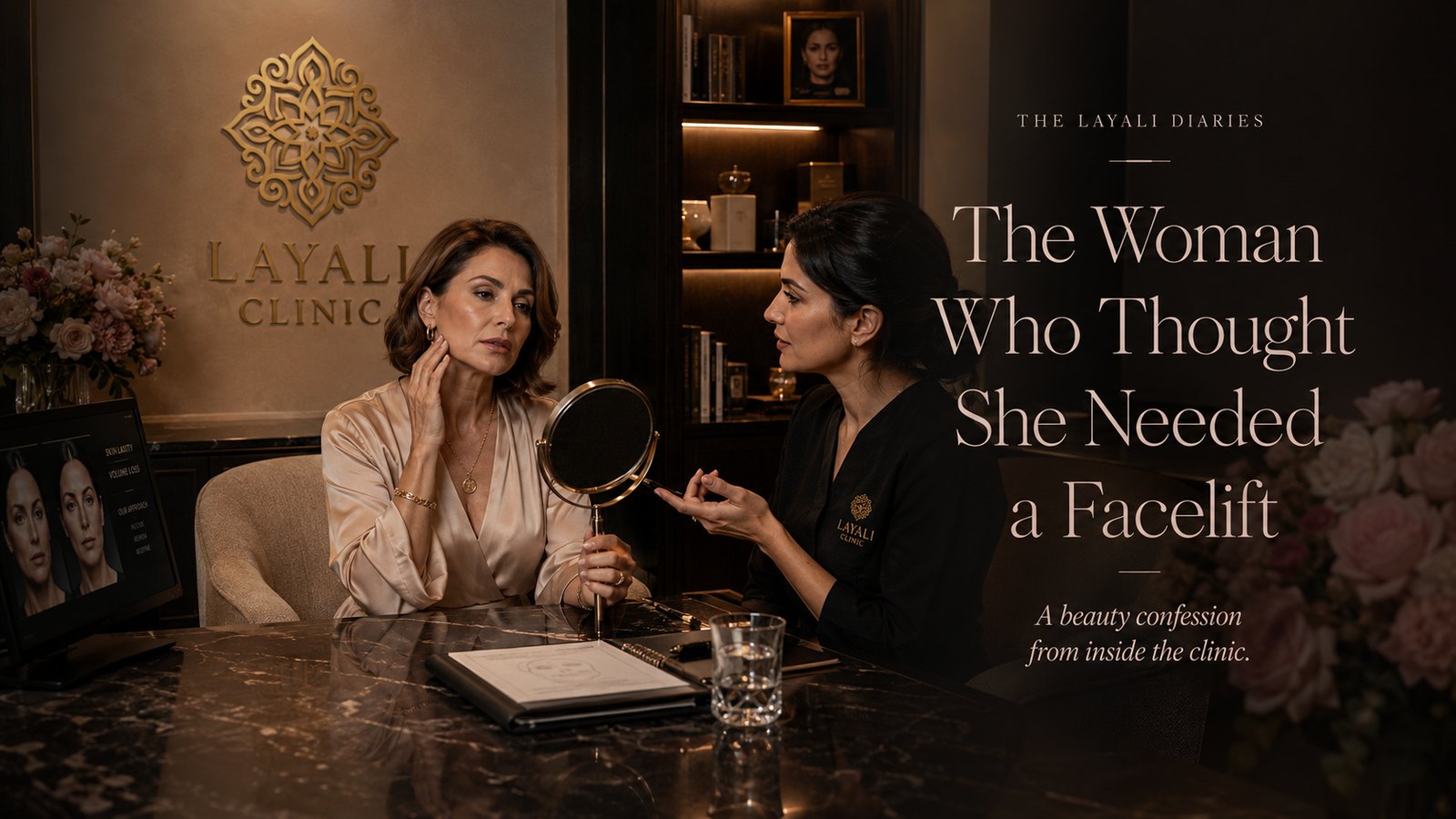
She arrived wearing a silk scarf, immaculate makeup and the expression of a woman who had already diagnosed herself.
"I need a facelift," she announced.
Not I am considering one.
Not What would you recommend?
She had decided.
Apparently, so had her bathroom mirror, her front-facing camera and one particularly unkind photograph taken at her sister's birthday dinner.
She placed the photograph on the consultation desk like evidence in a court case.
There she was, laughing beneath the unforgiving light of a restaurant chandelier.
Her head was turned.
Her chin was lowered.
And along her jawline sat the tiny fold that had somehow convinced her that her entire face was falling.
"I look ancient," she said.
She did not.
But somewhere between the birthday cake and the Uber home, she had enlarged the photograph, circled her lower face and begun researching surgeons.
By midnight, she was reading about recovery.
By 1am, she had saved three facelift clinics.
By morning, she had mentally removed fifteen years from her face.
All because of one photograph she had not approved.
The photograph that started everything
She was in her early fifties and undeniably elegant.
Her cheekbones were still visible. Her skin was well cared for and her face had retained much of its natural structure.
But she had begun to notice changes.
Her cheeks did not feel as full as they once had.
The line from her nose to the corner of her mouth looked deeper in certain lighting.
Her jawline seemed softer.
And when she leaned towards the mirror, she could see slight looseness through the lower face.
None of this was imaginary.
Faces change.
Skin changes.
Volume changes.
But noticing change and needing surgery are not automatically the same thing.
"What bothers you most?" I asked.
She lifted the skin beside her ears with both hands.
"This. I want everything pulled back."
A familiar demonstration.
It is usually performed beneath bright bathroom lighting, often with the head tilted upwards and occasionally while imagining the face one had at twenty-six.
The problem is that pulling everything towards the ears does not tell us what caused the change in the first place.
Was she seeing skin laxity?
Loss of facial volume?
Changes in the position of the tissues?
A reduction in definition?
Changes in skin quality?
Or a mixture of several things?
Because different problems require different conversations.
Surgery is not a dirty word
Let us make something clear.
A facelift is not a treatment that should be mocked, feared or automatically avoided.
A surgical facelift, also called a rhytidectomy, is designed to lift and reposition facial tissues to create a tighter, smoother appearance. It is a genuine surgical procedure with recovery, possible complications and limitations that should be discussed with an appropriately qualified surgeon.
For the right person, surgery may offer a degree of correction that injectables or skin treatments cannot reproduce.
Sometimes the honest answer is:
"You should speak to a plastic surgeon."
But the opposite is also true.
Not every softened jawline requires an operating theatre.
Not every shadow needs filling.
And not every woman who notices ageing needs to be immediately sold the most dramatic option available.
A consultation should determine what is actually happening before deciding what should be done about it.
The mirror test
I asked her to stop pulling her skin backwards.
Then we looked at her face properly.
Not through the restaurant photograph.
Not through a filtered selfie.
Not through the magnifying side of the mirror that should probably be illegal after the age of thirty.
We looked at her in natural movement.
Talking.
Smiling.
Turning from side to side.
Her concern was concentrated around the lower face, but the issue was not simply excess skin.
She had mild skin laxity, some loss of support through the midface and changes in facial volume that had altered the way light fell across her cheeks and jawline.
A facelift might still be something she considered in the future.
But it was not the only conversation worth having now.
"So what do I need?" she asked.
That was a better question.
The danger of treating every sign of ageing with filler
There was a time when almost every ageing concern seemed to receive the same answer.
Add filler.
Then add a little more.
Then place some beneath the first filler because the face still did not look "lifted" enough.
This is how a woman who originally wanted to look refreshed can slowly become unfamiliar to herself.
Facial ageing is not simply the disappearance of volume from one empty space. It involves multiple anatomical layers, and treatment planning must consider the face as a whole rather than chasing every line individually. Published anatomical reviews describe the role of structural changes and support when planning facial rejuvenation with fillers.
Dermal filler may be useful when carefully selected and placed to address specific areas of volume loss or structural deficiency.
But filler cannot remove loose skin.
It cannot recreate a surgical facelift.
And adding excessive volume to disguise laxity may leave the face looking heavier rather than younger.
Subtle structural support can sometimes improve balance.
"Filling until lifted" is not a treatment philosophy.
It is how faces lose their original proportions.
What collagen stimulation actually means
Her next question came with immediate suspicion.
"Are you going to put loads of filler in my face?"
No.
One option we discussed was collagen stimulation.
Collagen-stimulating injectables are not intended to create the same immediate, gel-like volume associated with traditional filler. Certain products are used to encourage a gradual tissue response, meaning changes develop over time rather than appearing as a dramatic instant transformation.
Evidence reviews of poly-L-lactic acid in facial aesthetics describe gradual collagen stimulation and potential improvements in selected ageing-related concerns, but treatment suitability, technique, risks and expected outcomes still need to be assessed individually.
That gradual process appealed to her.
She did not want to look "done."
She wanted to look less tired, slightly firmer and more like the version of herself she recognised.
But collagen stimulation was not presented as a magic solution.
It would not pull her face backwards.
It would not erase every fold.
And it would not produce a surgical result without surgery.
Its role would be to support a carefully planned approach, not to borrow the word facelift because it sounded more impressive.
Skin tightening without pretending it is surgery
We also discussed non-surgical skin-tightening treatments.
Depending on the technology used, these treatments aim to deliver controlled energy to selected tissue depths and encourage a remodelling response. Reviews of microfocused ultrasound and other energy-based approaches suggest that some appropriately selected clients with mild to moderate laxity may experience improvement. The degree of change varies, however, and these treatments are not equivalent to surgical lifting.
This distinction matters.
A non-surgical treatment should never be sold as a secret facelift with no scars, no recovery and identical results.
That sounds wonderful.
It also creates expectations that the treatment may never be able to meet.
Skin tightening may be worth considering when the concern is relatively mild and the client understands that any improvement is likely to be more subtle than surgery.
Where laxity is advanced, where tissues require significant repositioning or where the client wants a dramatic and lasting surgical-style change, a consultation with a suitably qualified surgeon may be more appropriate.
Good aesthetics is not about making every treatment sound powerful enough for everybody.
It is about knowing its limits.
The three-part plan
Her face did not need to be attacked from every direction.
It needed a calm, staged plan.
We discussed three possible priorities.
Improve skin quality gradually
Rather than chasing individual lines, the first focus could be the overall condition and firmness of the skin.
This might include a suitable collagen-stimulating or skin-focused treatment, depending on her medical history, assessment and preferences.
The goal would not be instant transformation.
It would be gradual improvement.
Assess whether structural support was needed
She had some loss of midface support, but that did not mean filling every visible hollow.
A small amount of carefully selected filler might be considered in strategic areas if it would genuinely improve proportion and support.
The key word was small.
We would rather under-treat, review and decide that no more was needed than add unnecessary volume because she had arrived expecting a dramatic procedure.
Dermal fillers are medical devices and carry risks, including rare but serious complications if material is unintentionally injected into a blood vessel. Any treatment therefore requires informed consent, appropriate product selection and a practitioner able to recognise and manage complications.
Review the skin laxity honestly
After the skin and underlying support had been assessed over time, we could review what remained.
If the remaining concern was true tissue laxity beyond what a non-surgical treatment could reasonably improve, surgery would still be available as a conversation.
Starting conservatively did not close the door to a facelift.
It simply prevented her from walking through it before understanding why she wanted one.
"How quickly will I look younger?"
There it was.
The question hiding beneath every other question.
Not How will the treatment work?
Not What are the risks?
Not even Will I look natural?
How quickly could we reverse time?
I told her the truth.
We were not going to make her twenty-five.
We were not going to erase every sign that she had lived, laughed, raised children, experienced stress, celebrated birthdays and spent years expressing herself.
The aim was not to remove her age. It was to help her feel more comfortable with the changes she was seeing without turning her face into a battle that had to be won.
Some treatments may create an immediate visual change.
Others develop gradually.
Some concerns may improve.
Others may remain.
And every cosmetic procedure, surgical or non-surgical, carries potential risks that should be understood before proceeding.
She was quiet for a moment.
Then she looked back at the restaurant photograph.
"I suppose I don't actually want a different face."
Most women do not.
They want their own face back.
The difficulty is accepting that the face they remember was photographed in another decade.
What we decided
She did not book a facelift.
She did not book five syringes of filler either.
We agreed on a staged, conservative plan beginning with treatment intended to support gradual collagen production and skin quality.
Once that process had been given time, we would reassess her face and decide whether any subtle structural support was necessary.
No chasing folds.
No overfilling the cheeks in an attempt to pull the jawline upwards.
No pretending that one appointment could reverse every layer of facial ageing.
Most importantly, there was no pressure to begin immediately.
A cosmetic treatment should be chosen after understanding the alternatives, limitations and possible risks — not because one bad photograph has created an emergency.
Several months later
She returned carrying a different photograph.
This one had been taken outside.
No strategic lighting.
No filter.
No one had asked her to pose.
She was laughing again, but this time she had not zoomed in on her jawline.
"My face looks fresher," she said.
It did.
The change was not dramatic.
Nobody had stopped her in the street to demand the name of her surgeon.
Her skin appeared healthier, her face looked balanced and she still looked completely like herself.
We discussed whether a small amount of structural support might add anything meaningful.
After looking in the mirror, she shook her head.
"Not yet."
Those two words may be the most underrated treatment decision in aesthetics.
Not never.
Not absolutely not.
Just not yet.
She may choose surgery one day.
She may continue with conservative treatments.
She may decide to do nothing further at all.
Every one of those choices is valid when it belongs to her rather than to a photograph, a trend or a practitioner's sales target.
Because sometimes a woman does need a facelift.
Sometimes she needs a different treatment plan.
And sometimes she simply needs someone honest enough to explain the difference.
Until the next confession,
The Layali Diaries x